























Dubbed one of the greatest songwriters of all time by Rolling Stones Magazine, Joni Mitchell is an icon in the music industry who has inspired listeners through her words from the very start. Mitchell is a Canadian-American singer and songwriter — and painter — known for her lyrical ballads and creative compositions. Her career began with performances in small night clubs throughout Western Canada. She soon gained enough traction to move her influence to Toronto until she eventually made the move to the United States, settling in Southern California, and began touring in 1965. In order to sign with a label, Mitchell allowed for some of her original songs to be recorded and released by other singers first. Among these are some of her most well known tracks such as, “Both Sides, Now” and “The Circle Game.” In late 1967, she signed with Reprise Records and her debut album, titled Song to a Seagull, released in 1968.
Mitchell’s masterpiece is considered to be her album Blue, released in 1971, as it’s often cited as one of the greatest albums of all time. Ranked number three on Rolling Stone Magazine’s list of “The 500 Greatest Albums of All Time,” they say, “Blue is the first time any major rock or pop artist has opened up so fully, producing what might be the ultimate breakup album and setting a still-unmatched standard for confessional poetry in pop music.”
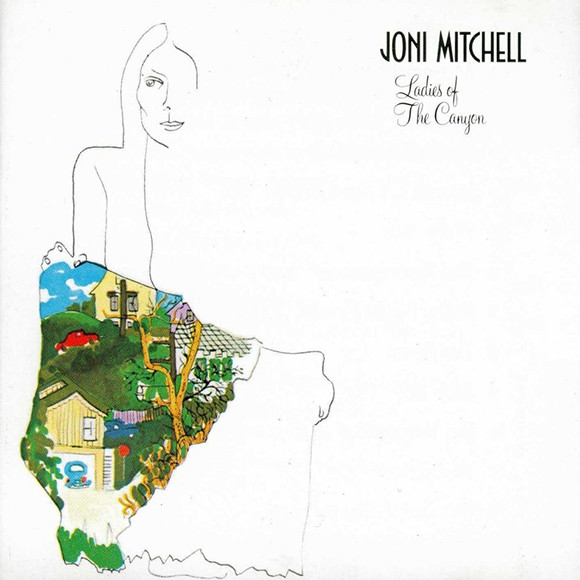
Among the rest of her discography lies her third album, released in 1970. Titled Ladies of the Canyon it’s another notable work that in many ways serves as a transitional piece. With this 12 track piece (10 of the most notable are listed below) she worked towards her goal of creating music that carried a greater meaning than just a voice and some words.
- “Moring Morgantown” – Revisiting the folk style of her past songs, this track starts the album out by painting a picture of ideal small-town life, highlighting the beauty of everyday things in Morgantown.
- “For Free” – This track touches on the idea of what happens when passion becomes a commercial transaction, a question that Mitchell had to sit with as she started to gain more popularity with each new release. The song compares the struggles of a street artist who plays ‘real good for free’ to a mainstream artist and the rewards that come with their fame.
- “Conversation” – “Conversation” portrays a relationship of a love triangle where the narrator has fallen for a man in a toxic relationship with another woman. The narrator provides support for the man while wishing he would be with her instead.
- “Ladies of the Canyon” – The album’s title song is written about three real women, Trina Robbins, Annie Burden and Estrella Berosini, that Mitchell knew in the bohemian Los Angeles neighborhood of Laurel Canyon and is a celebration of female creativity. The song paints a portrait of their communal and artistic lifestyle anchored in a “sisterhood.” The lyrics intricately discuss each of the women’s personalities, their ways of life and how they are all “pouring sunshine down the canyon.”
- “Willy” – Filled with lines like “I would be his lady all my life,” and “Willy is my joy, he is my sorrow,” this song is about Mitchell’s relationship with Graham Nash, of the group Crosby, Stills, Nash & Young. In it, she lays her relationship out for all to feel and understand.
- “The Arrangement” – A criticism of social status and materialistic tendencies, this song is written from the perspective of an observing mistress and tags on a theme of being more than what we possess. It also matches the mood of her next album Blue.
- “Rainy Night House” – A farewell song to a short but meaningful relationship, Mitchell illustrates a memory spent at the childhood home of a man born into wealth who longs to live for a different meaning.
- “Big Yellow Taxi” – With this track, Mitchell moves back to writing about the problems of the world. With an upbeat pop melody she writes, “They paved paradise, put up a parking lot” she creates an environmental protest song that also has a hint of romanticism. The short but profound song was her first hit single and continues to be one of her most known songs.
- “Woodstock” – Even though she didn’t attend the festival, this song perfectly captures the importance of Woodstock and helps current day listeners grasp its meaning to understand why it has such an impact. She writes about the festival as a paradise where “we are stardust, we are golden” and uses symbolism such as “bombers turning into butterflies” to carry a meaning of peace, while altogether highlighting the importance of coming together.
- “The Circle Game” – Representing the cycle of life as the spinning of a carousel, Mitchell writes, “We’re captive on the carousel of time/ We can’t return, we can only look/ Behind from where we came/ And go ‘round and ‘round and ‘round/ In the circle game.” The song follows a young boy’s life to becoming a man as his “cartwheels turn to car wheels though the town,” a vivid picture of the tender feeling that change brings created with her words.