










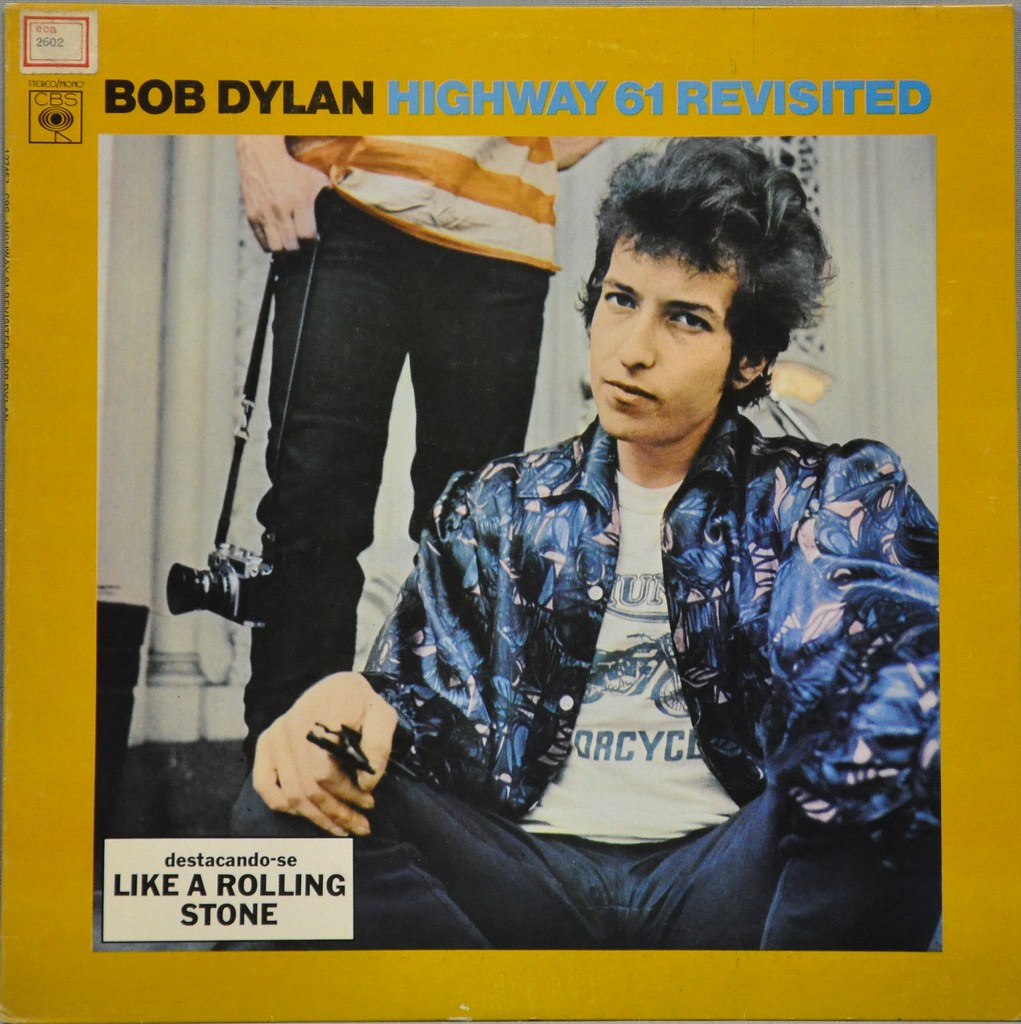














After writing five albums in the folk-rock genre, writing songs that felt more like stories and protest, Bob Dylan was a star. For his release of his next album called Highway 61 Revisited, he took an unexpected genre turn, but still sported his signature harmonica flares here and there. Released on August 30, 1965, the term “folk-rock” couldn’t even come close to representing his new piece, in fact it was representing a new hybrid genre, unlike anything that came before it. Dylan went electric.
Just a month before the release of this album, Dylan took the stage at the Newport Folk Festival and would go on to perform one of the most famous performances of all time. In front of a festival crowd of folk music fans, Dylan, backed by an electric band, performed one of his new rock hits named “Like a Rolling Stone,” that would go on to be featured on Highway 61 Revisited. The folk-loving audience was shocked, expecting to be serenaded with story telling and an acoustic line-up but instead hearing the blare of electric guitar to open the set. Some took to booing, hoping to get to hear what they came to the festival to hear, others cheered, finding the change to be exciting. This performance marked Dylan’s musical independence, releasing him from the expectations of a genre as he instead took himself down the path less travelled.
This album is regarded as Dylan’s electric masterpiece and remembered for the impact it had on the music scene at the time of its release. Even Dylan himself agrees that this album is special as he said at the time of its release that “I’m not going to make a record as good as that one,” because it was more than just a new album, it was an artistic statement.
- “Like a Rolling Stone” – Starting with the most successful tune of the album, in fact it’s the one that Rolling Stone named the greatest song of all time in their 2004 ranking. After being burnt out from a long tour in the UK, and facing criticisms from going electric, Dylan considered quitting the music industry altogether. That was until he came up with a song. He told Playboy in 1966 that, “Last spring, I guess I was going to quit singing. I was very drained, and the way things were going, it was a very draggy situation … But ‘Like a Rolling Stone’ changed it all. I mean it was something that I myself could dig. It’s very tiring having other people tell you how much they dig you if you yourself don’t dig you.” Starting off as ten pages of word ranting, it was shortened to 6 minutes for the release of the single. It tells a tale of a female character who rolls through life and fills it with shallow superficialities, all stemming from the saying “a rolling stone gathers no moss.”
- “Tombstone Blues” – A high energy, blues-rock style critique of 1960s society and, in true Bob Dyaln fashion, is regarded as a protest song attacking authority and hypocrisy. The imagery of the lines and the satire behind it all take listeners back to the chaos of the Vietnam War era, which is even reflected in the frantic tempo of the song.
- “It Takes a Lot to Laugh, It Takes a Train to Cry” – The song takes listeners through the back and forth of a frustrated couple. Throughout it, a train metaphor is used to represent the passion caught between the two while simple imagery is weaved through the lines like “Don’t the moon look good, mama / Shinin’ through the trees?” and, “Don’t the sun look good / Goin’ down over the sea?” to create a song rooted in a story.
- “From a Buick 6” – Another blues track of the album, this song contains lines that are both funny and profound meant to describe the troubled mind of the narrator. Some critics interpret the song to be a tribute to a nurturing and supportive woman figure while others suggest that the song contrasts a “graveyard woman” or a wife to a “soulful mama” or a mistress, insinuating that its a cheating song. Others even think the lyrics are metaphors for drug use. No matter the interpretation, the high energy of this song makes it catchy none the less.
- “Ballad of a Thin Man” – Centered on the clueless character “Mr. Jones,” this song aims to mock those who demand explanation for things that don’t make sense to them. Written in the context of the counterculture, art and social changes of the 1960s, Dylan directly address “Mr. Jones” as he opens the song with a scene to that sets the tone right off the bat, “You walk into the room/ with your pencil in your hand/ You see somebody naked/ and you say “Who is that man?”/ You try so hard but you don’t understand/ Just what you’re gonna say when you get home/ Something is happening here and you don’t know what it is/ Do you, Mr. Jones?”
- “Queen Jane Approximately” – This song is often interpreted as a prelude to “Like a Rolling Stone” due to their similarity of having a female centered character. The song mocks this high society woman who is falling out, losing her friends and status, while encouraging to abandon her superficial life and to live a more authentic one. Some interpret “Queen Jane’” to be a no to Joan Baez, who was known as the queen of folk and had a complicated relationship with Dylan. Overall, the song plays out as a social critique.
- “Highway 61 Revisited” – The opening of this song is like any other song. The piercing siren of a toy whistles welcomes the rest of the upbeat song. Highway 61 itself is 1,400 miles long and runs from New Orleans – the ‘birthplace of the blues’ – up to Dylan’s home state of Minnesota. With the sound, Dylan starts with a verse about the biblical story of Abraham, but quickly shed religious convention as he nicknames Abraham “Abe” by the second verse. He continues allude to stories and characters for the remainder of the song while drawing everything to the symbolic significance of Highway 61. Dylan represents it as an escape from personality responsibility that weighs on everybody to try and see the best in a world that isn’t always great.
- “Desolation Row” – The album ends with a song that feels like Dylan’s previous work as its the only acoustic one. In it, Dylan takes listeners through a ten minute journey of a song that offers a nice winding down feeling, appropriate for the end of this album. The song is often regarded as one of Dylan’s most lyrically sophisticated songs so the meaning of it is different for every person. The most common interpretations have said that the song is about an apocalyptic version of society filled only with historical, literary and pop-culture figures.