
























Historic jewels worth over 100 million dollars and rich history were quickly stolen from Paris, France at the Louvre Museum. The Louvre museum holds ancient artifacts dated back to the Napoleonic era and is the most visited museum in the world. Laurence des Cars, the current president of the museum, mentioned this being a terrible reflection on the museum since most valuable treasures are in their possession and are supposed to be strictly monitored. The only camera was installed west and did not capture the break-in point where the robbers entered, using an angle grinder to break through the old doors.
The heist unraveled at 9:30 AM on Sunday October 19th. The thieves parked a truck equipped with a mobile ladder outside the Louvre along the Apollo Gallery’s side entrance. At 9:34 AM, they triggered an alarm on the second floor which immediately alerted the security post. As the thieves drilled holes in the glass to access the jewels, alarms were activated on the two high-security displays that protected the valuables. The police were called at 9:36 AM. Just a minute later, the heist was over. The thieves fled the scene at 9:38 AM, leaving the building on scooters along the Seine.
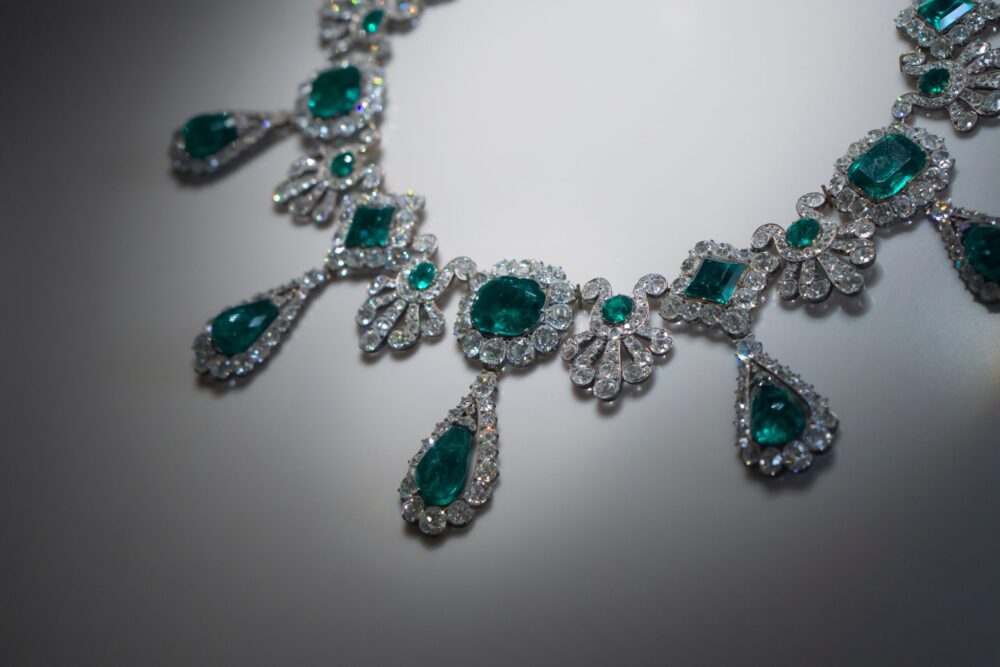
Experts say the stolen prices are likely to be dismantled for their raw materials resulting in destroyed artifacts and lost history. The nine stolen artifacts include, a tiara, necklace and a single earring from a sapphire set belonging to Queen Marie-Amélie and Queen Hortense; an emerald necklace and earrings from Empress Marie-Louise; a reliquary brooch; a large corsage bow brooch; and Empress Eugénie’s tiara.
The sapphire set was in association with two French queens, Hortense de Beauharnais and Marie-Amélie. The exact origins of this set are unknown however, the craftsmanship points to Parisian jewelers of the early 19th century. The first piece of this set was the tiara. This tiara contains 24 Ceylon sapphires and over 1,000 diamonds. The stones are able to detach and be worn as brooches. The next piece in this set was the necklace, made of eight large sapphires alternating with 631 diamonds, designed to sit high on the neckline. The last piece to the set was the earring(s). The earring pair is now a single earring, the other earring was lost sometime in history.
The other set stolen was the Marie-Louise set. This was commissioned by Napoleon I for his second wife, Empress Marie-Louise, for their marriage in 1810. Around 1955, Van Cleef & Arpels, a jewelry house, removed all the original emeralds from the diadem and sold them separately. Later between 1956 and 1962 they remounted the diadem with turquoise stones. The necklace and earrings were acquired by the Louvre museum in 2004.
Empress Eugénie’s jewelry collection consisted of the large diamond bow brooch, originally part of a massive diamond belt and her pearl and diamond tiara. The tiara was created by the jeweler Alexandre-Gabriel Lemonnier in 1853. It includes a delicate diamond foliage design bordered with pearls. The diamond brooch was the centerpiece of a large diamond belt worn by Eugénie during visits from Queen Victoria in 1855. The belt was taken apart and redesigned into a bow brooch. The bow was purchased by the Louvre museum in 2008.
The reliquary brooch, dating back to the 17th century, holds significant historical importance. Commissioned by Empress Eugénie of France in 1855 from the renowned jeweler Alfred Bapst, the brooch was intended to serve as a symbol of faith. Made out of 94 diamonds from top to bottom, the two diamonds at the center of the brooch were once used by Louis XIV as buttons for his clothing. To preserve the history for future generations, it was bought by the Louvre in 1887.
Des Cars says that the power tools used to cut through the displays were made for concrete, explaining that the cases held up well and video footage revealed robbers struggling to get the pieces. However, new details and security adjustments will be made as the Committee of Cultural Affairs of the National Assembly are in contact with Des Cars to secure the museum and prevent future heists like this one.
Currently, none of the items are returned or recovered and some of the robbers have yet to be apprehended, there is still an active one at large. However, four individuals that are believed to have been involved in the robbery were arrested and charged for theft. In response to the heist, the Louvre has transferred some of its most precious jewels to the Bank of France to protect them from further losses.