

























On Wednesday April 1, 2026, four astronauts lifted off from the Kennedy Space Center in Florida on a ten day journey around the moon as a part of NASA’s Artemis II mission. Artemis as a whole is NASA’s program to send astronauts back to the moon, the name coming from Greek mythology as Artemis is the twin sister of Apollo, the name of the first manned mission to the moon. The end goal is to land humans on the moon again, explore the surface of the moon and build a lunar space station which will lay the ground work for sending astronauts to Mars.
The four crew members are Ried Wiseman, Victor Glover, Christina Koch and Jeremy Hensen. Wiseman is the commander. After graduating from Rensselaer Polytechnic Institute in 1997, Wiseman served in the U.S. Navy as a fighter pilot. After serving two deployments in the Middle East, he joined NASA in 2009. Around the time when he started serving as the chief of NASA’s astronaut office, Wiseman lost his wife to cancer. He left this position in 2022 and then found out he had been selected to lead the moon mission in 2023, requiring him to leave his now alone daughters back on earth as he went to space, but with their support he was able to follow through with the mission.
The pilot of the Artemis II mission is Victor Glover. He finished college in 1999 and became a naval aviator who served in Iraq. Later, while working in Senator John McCain’s office in 2013, NASA selected him to be an astronaut. He was the first Black astronaut to serve on a long term mission at the space station and, after this mission, will be the first Black person to fly around the moon.
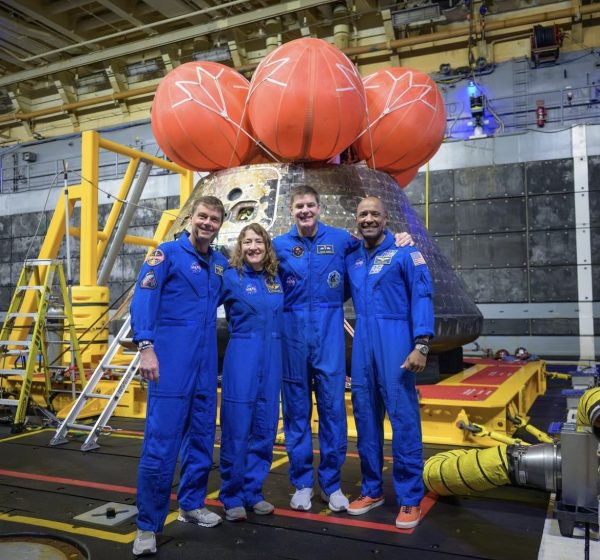
This is not mission specialist no. 1, Christina Koch’s, first time making history. In 2019, she and astronaut Jessica Meir completed the first all female space walk aboard the International Space Station, and after 328 days in space, she set the record for the longest single spaceflight by a woman. That being said, she likes to relish in the idea of these accomplishments, saying it does a disservice to the actual work being done. Koch graduated from North Carolina State University and went to work at the Goddard Space Flight Center before doing research at the South Pole. After this, she became an electrical engineer at John Hopkins University Applied Physics Laboratory where she developed instruments for NASA.
Mission Specialist No. 2, Jeremy Hansen, will be the first Canadian to travel to the moon. Canada is an international partner of the Artemis program and has provided equipment and money as a part of the collaboration of going to the moon. Because of this, a seat was saved for the Canadian Space Agency (CSA). Hensen joined the CSA after working as a pilot in the Royal Canadian Air Force. He is the only member in the crew that has never been to space before, even though being an astronaut has been a dream of his for all his life.
Artemis I was launched in November of 2022 and was an uncrewed test flight. Artemis II was designed with the intention to test out the systems of the spacecraft the crew is flying in called the Orian, given the name of Integrity by the crew, as well as to witness and make observations of the surface of the moon as become the first sets of eyes to see the far side of the moon. With this they will also be doing experiments on the effects of deep space on the body as this mission will take the crew further than any human has gone before.
After eight minutes of lifting off, the crew was properly in space and ready to begin their mission. On Day one, they had to deal with computer and communication glitches, along with a malfunctioning toilet. They also performed a manual test drive and procedures. This was all done while staying in the Earth’s orbit, designed into the mission so that if anything was seriously wrong, they could stop and come back down fairly simply.
On day two, the astronauts fired up the engine of the Orian to begin leaving the Earth’s orbit and started on their path towards the moon. Days three and four were quieter, save for the continued problems with the toilet, but the crew members were able to talk with their families. On day five the crew prepared from the lunar fly-by that was the following day.

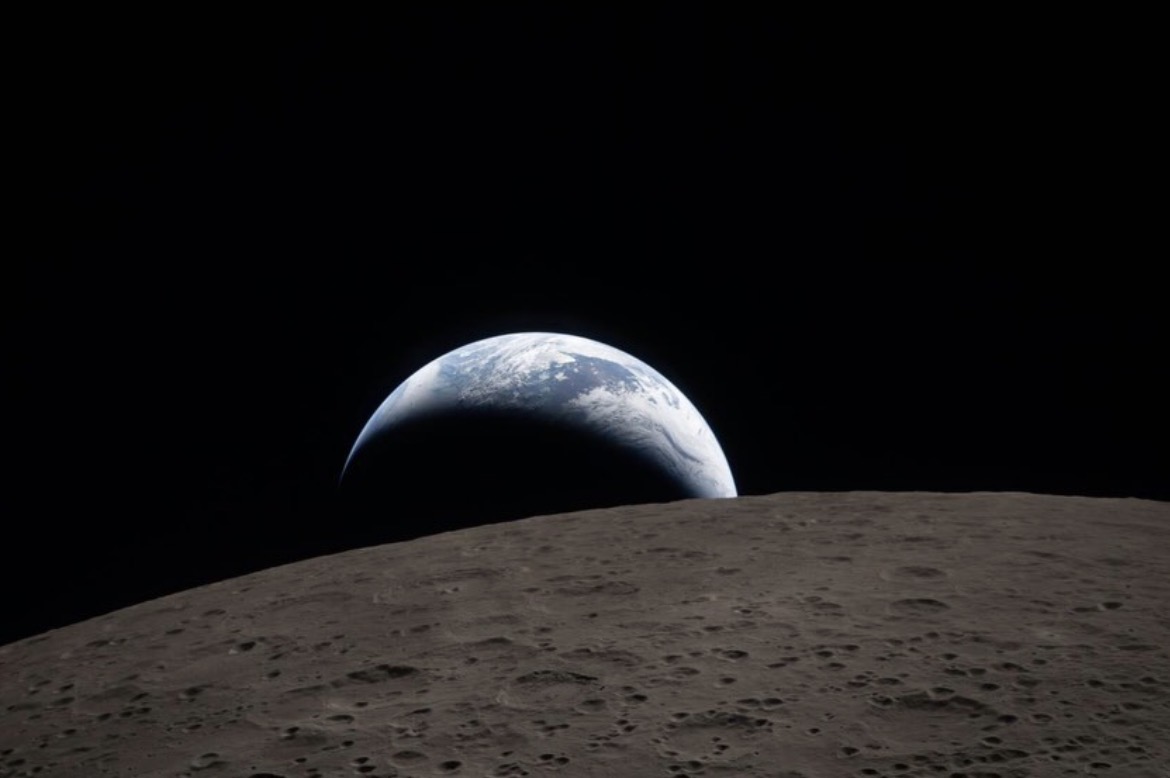
Day six was the day to remember. As the spacecraft flew around the far side of the moon, which had never been seen before, the crew took to making detailed scientific observations and data about the surface of the moon never before observed by the human eye. During this time, no radio contact from Earth could reach them, so it was forty minutes of blackout. In total the crew spent seven hours observing the moon, working with the science team back on Earth. During this time the crew observed a 53 minute solar eclipse as the moon passed in front of the sun, five flashes of small meteors hitting the surface, newly formed craters that were lighter than anything around it, as well as two previously unnamed craters. The crew requested that one be named Integrity after their space craft. The other one, which was a bright spot on, was named Carroll after commander Wiseman’s late wife. During this moment, the crew collectively shed a few tear while Wiseman’s two daughters looked on from the visitors gallery.
With this, they broke the record for the furthest any human has ever been from Earth, 252,756 miles to be exact, beating the previous distance set by the crew of Apollo 13 in 1970. Hansen, a member of the space crew, told the New York Times that, “We most importantly choose this moment to challenge this generation and the next to make sure this record is not long-lived.”
The seventh day was mostly rest, on the eighth they were able to chat with there colleagues on the ISS and recap their flyby observations. By the ninth they were preparing for the splashdown on the following day, making a slight corse correction to make sure they would land on their target. On Friday, April 11, the crew successfully landed in the pacific ocean off the coast of San Diago, and with that the achievement of completing a historic return to human spaceflight to the moon, opening a new chapter of space exploration.
The mission created “moon joy,” a catchphrase created by the crew and mission control, for all the spectators that followed as the rocket lifted off in Florida to when they splashed down in the Pacific Ocean. This was an important message that the crew wanted to emphasize along with their new observations. As Glover explained from space, “You’re on a spaceship called Earth that was created to give us a place to live in the universe. … [Let’s] find common ground,” and Wismann in an interview from before the mission, “I hope we have a great impact on bringing the world together, even just for a minute.”
As the crew left an increasingly divided world behind, they hoped their mission would inspire a sense of connection—while also opening a new chapter in space exploration.