
























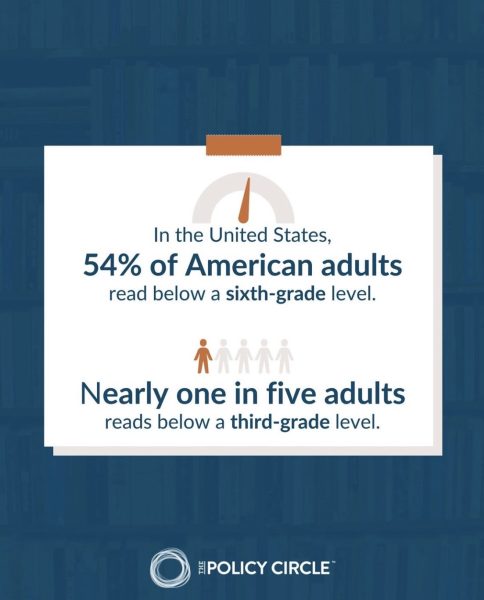
In 2025, high school seniors’ reading levels were recorded at their all time low since 1992. For American adults ages 17-74, an estimated 58% (130 million) hold a literacy rate below the sixth grade reading level. Literacy Buffalo Niagara, an organization dedicated to encouraging the development of literacy skills by tutoring adults in the Erie and Niagara area, shows that 28% of adults display a literacy rate below the third grade reading level or a level one on a five-level scale.
Declining literacy rates across the US create cause for concern in nearly all aspects of life. Literacy, as defined by The National Literacy Trust, is the ability to read, write, speak and communicate effectively while also measuring competence in specified areas. Without these essential skills, societal function becomes impossible. Without literacy, political participation dramatically decreases, economic loss ensues and reliance on social welfare programs increases, which is why the problem with learning needs to be addressed immediately.
As a basic civil right, literacy should be something inherent in everyone’s lives. So why is it not? ProLiteracy, whose mission is to fund literary programs for adults across the country, explains that much of the plummeting literacy rate is due in part to poverty and unequal opportunity: “Nearly 80% of those who live in poverty read at a Level two or below, and the interconnected cycles of poverty and low literacy perpetuate each other.” Economic status directly affects access to higher education which in turn creates greater opportunities for advancing literacy. For those economically disadvantaged, advanced reading and writing proficiency can be unattainable and secondary to work. Similarly, schools in impoverished areas often graduate less students successfully due to low literacy levels. Prior to schooling, literacy level can also be impacted by the household environment. Parents’ or guardians’ education has a direct correlation to skills of children, causing a cycle of intergenerational low literacy (ProLiteracy). In order to break this cycle, educational opportunities must be equalized. Many communities across the country have set up organizations which work to improve literacy, like the aforementioned Literacy Buffalo Niagara. There are also national organizations working towards this common goal. For example, the National Center on Improving Literacy (NCIL) advocates for every child to have the access to resources that will help them become confident, skilled readers. The organization is funded by the Department of Education and is led by Boston University, Florida State University and the RMC Research Corporation.
Not only is literacy rate hindered by lack of access to education, but also by the denunciation of literacy related disorders including dyslexia. Undiagnosed dyslexia can have a significant impact on the literacy rate due to adolescent frustration with the disorder. If left unidentified, dyslexic children can go years struggling to read and write, therefore affecting their abilities later in life. The NCIL’s website holds various tools that can help parents understand disorders like dyslexia and encourages therapies that may help those diagnosed.
The issue of undiagnosed dyslexia carries back into unequal education opportunities. Public schools who identify dyslexia in students often don’t have the resources and staffing to address it. Without those resources, students can go years before getting help and it can often snowball into affecting future careers and educational opportunities.
Addressing income gaps, educational equality and literacy disorders can help restore the literacy rate to what it should be. While it’s easy to identify the common causes for low literacy, it is often harder to find a solution to them.
The ability to raise the literacy rate in the US comes down to civil service and education reform. Education and help should be affordable and easily accessible for those who need it. The Center for American Progress (CAP) explains that by providing a strict and clear guideline for government spending on education can encourage the growth of literacy programs working towards a higher literacy rate. “When allocating these funds, the Education Department should give competitive preference to clinics and other educational programs that provide teachers with opportunities to work with certified reading specialists to identify struggling readers, learn best practices that can be applied to an entire classroom and provide resources to support students in clinic, in class and at home,” CAP argues.
With the decline in adult illiteracy threatening the welfare of the United States, these programs are more important than ever. The equality of educational opportunity for both children and adults is argued by teachers and officials to be the most effective way of improving the literacy rate. Similarly, addressing a potential solution for cyclic poverty can also improve the rate. In all, the decline of the literacy rate should be at the front end of policy because without a population dedicated to education, the world cannot thrive.